Solo theatre in rural Burgundy: a practical scene
A look at solo theatre in rural Burgundy, small touring companies, village halls and the practical work behind one-person shows.
- Published: September 16, 2026
- 981 words
- 6 min read
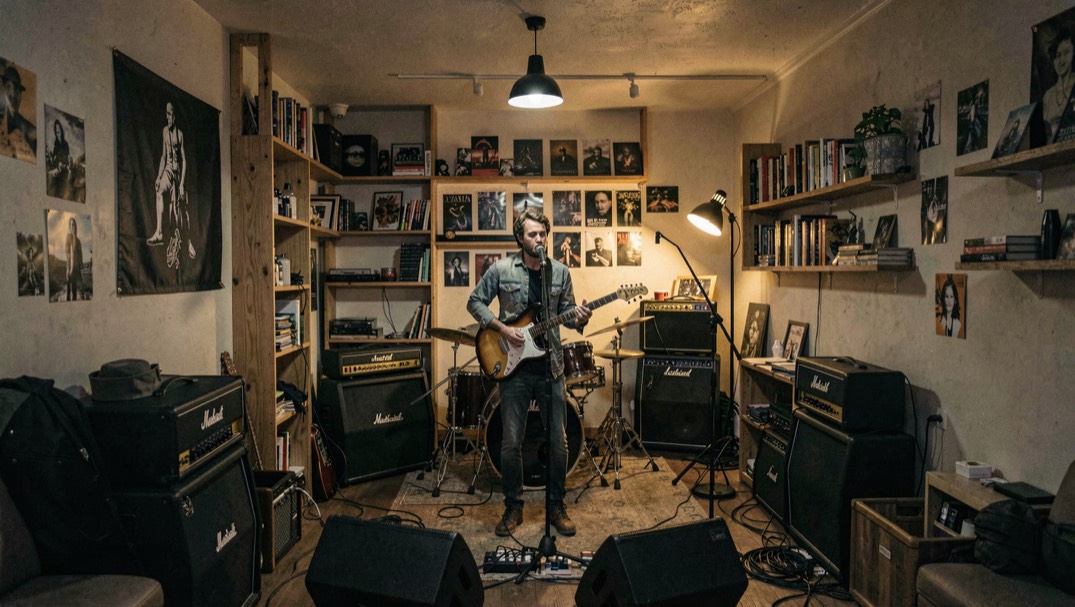
Solo theatre in rural Burgundy is a working scene, not a niche curiosity. Companies based around Cluny tour one-person shows into village halls and heritage venues, carrying light equipment and small budgets. The work is documented in French at theatre in solo in Burgundy, a practical magazine titled Le Rideau de Bourgogne.
What does solo theatre in Burgundy actually consist of?
A solo show in this region usually means one performer on stage with a text and very few objects. The repertoire described by Le Rideau de Bourgogne includes a poetic incantation of Péguy, Mozart letters performed with a keyboard, notebooks from Lisieux read aloud, and a medieval narrative linked to Cluny with water staged through light means. These are not adaptations of large casts reduced to one actor. They are formats written or assembled for a single voice, where the text carries the evening and the staging solves practical problems rather than adding decoration.
The choice of material says something about the audience. Péguy, Mozart's correspondence, the Lisieux notebooks and a Cluniac medieval story are all texts with a strong oral dimension. They work when read or spoken in a room of forty people, without amplification, without a set that takes two hours to install. The water element in the Cluny narrative is a good example of the approach: a visual idea that can travel in a car and be set up in a hall that was not designed as a theatre.
How does a small touring company operate?
A small itinerant company in this context is usually an association. It relies on volunteers, keeps a sober budget, and combines public and private support. Le Rideau de Bourgogne describes this as the ordinary working structure of the scene: an association status, a team that is partly unpaid, and a financial model that does not assume a full house every night. The company also maintains archives of its shows, runs a book and record shop, and organises writing workshops and pottery activities. Those side activities are not marketing. They are part of how the structure survives between performances.
The budget question is central. A company that tours village halls cannot count on ticket revenue alone, because the capacity of a salle des fêtes is limited and the ticket price has to stay accessible to local residents. Public support, from the commune, the department or the region, and private support, from local businesses or associations, fill the gap. Volunteers handle transport, accommodation, communication and sometimes the technical set-up. This is a model that rewards patience and local relationships more than rapid growth.
Why do village halls and heritage venues matter?
Rural touring in Burgundy takes place in salles des fêtes and heritage sites. Each date requires scouting the venue, agreeing on how the company will be received, and planning light lighting. The room is often used for other purposes during the week. The stage may be a platform at one end of the hall, the acoustics may be reverberant, and the power supply may need checking before the performance.
Le Rideau de Bourgogne treats this as a craft in itself: repérage, accueil, lumière légère, voisinage et mémoire des passages. The last point is important. A village remembers which companies came, what they performed and how they behaved. That memory shapes whether a company is invited back. For a small structure, a good relationship with a commune is worth more than a press article.
Who is the audience for these shows?
The audience is mostly local: amateurs, teachers, association volunteers, local programmers and villagers. Some are regular theatre-goers, others are not. A solo show in a village hall has to work for both. That is why the formats tend to be direct, spoken, and built around a text that can hold attention without technical effects.
Teachers use these performances as an extension of their work on literature or history. Volunteers from local associations see them as a way to keep a communal space active. Programmers look for shows that can fit a small stage and a modest fee. Villagers come because the performance is nearby, affordable and part of the life of the place. The mix is not a problem to be solved. It is the condition under which the scene exists.
What can independent musicians learn from this model?
A musician building a live set before a release plan faces similar constraints. The Burgundy solo theatre scene shows a way of working that does not depend on scale. One performer, a text, light equipment, a room that is not a dedicated venue, and a local network that carries the date. The production choices matter as much as the content, because the content has to survive the conditions of the room.
A small touring company also shows how to document its own work. Archives of shows, a shop of books and records, writing workshops: these are ways of keeping a practice visible between performances. For an independent musician, the equivalent might be recording live versions, keeping a list of venues that worked, and maintaining contact with the people who hosted the show. The scene around Cluny is not a model to copy. It is a reminder that a live practice can be built slowly, in one region, with the means at hand.
What is happening now in the region?
The activity described by Le Rideau de Bourgogne is ongoing rather than seasonal. Companies continue to tour solo texts into village halls and heritage venues around Cluny, combining performances with workshops and the daily work of an association. The magazine documents texts taken to the stage, the craft of the small itinerant company, and the practicalities of rural touring. For anyone following independent live work in France, it is a useful record of how one region keeps a performance scene alive outside the main cities.
A solo show in rural Burgundy often travels with a small van, a lighting bar and a handful of props, so the programme stays flexible from one village hall to the next. The same patience applies to watching films: a season built around a single mood rewards the audience that follows it week by week. Readers who want to see how that works can open a film noir seasonal cycle on this site, where the run is set out in order. For a touring performer, that model is useful: a fixed frame, a changing room, and a public that returns.